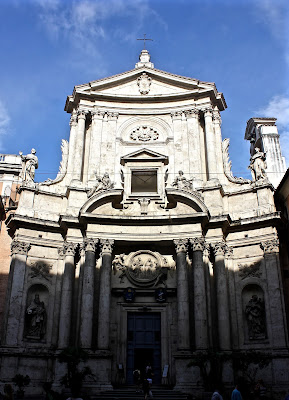
Saint Frances' Monastery.

Today is the feast of Saint Frances of Rome, Santa Francesca Romana, the city's female patron saint and fourth after Peter, Paul, and Lawrence. On her feast day, it is possible to visit the Tor de' Specchi monastery founded by the saint herself. Francesca Ponziani was a Roman noblewoman who received her calling to a religious life after her two sons died and her husband got severely ill. Her mission began by opening her house, together with her husband, to Rome's sick and poor. Once the husband passed, together with a community of women, and after a divine vision of an angel who became her constant companion, she founded the monastery in 1443 as an oblate community, based on the Benedictine rule. These communities were rather common in the late Middle Ages and early Renaissance in Rome, and theirs was a mission of charity and outreach to the least advantaged. The oblates conducted simple lives based on the ora et labora rule, working and helping the sick and the poor. It all began on 15th August 1425, on the feast of the Assumption, when ten women led by Saint Frances offered themselves as oblates, founding a community at Santa Maria Nova al Palatino - the Olivetan monks' basilica. They dedicated themselves to charitable works while still living with their families, often rich and part of the new bourgeois or nobility. For centuries this order was associated with the Roman aristocracy as a way to give back to society as a whole. On 25 March 1433, they rented a house in the Rione Campitelli near a tower called Torre degli Specchi (now lost) - here the oblates begun to live a fully common life. It was here, in her cell that during an ecstasy, Frances with the inspiration of the Blessed Virgin Mary with Saint Paul, Saint Benedict and Saint Mary Magdalene, dictated the rule of the order, based on the Benedictine one. On 4 July 1433, Pope Eugene IV recognized the order and gave them the right to choose a president and their confessor. In 1439, the Olivetan monks recognized their order and gave them autonomy, as well as the right of honorific burial in Santa Maria Nova for each sister. Saint Frances' body still lies at the hear of the basilica in the Roman Forum.

Today, this community still survives and through the centuries it has never ceased to help the poor and the sick, especially young women, following the example of Saint Frances. Today they share their beautiful house with poor students and the elders.
When I entered the XV century house today, it was like going back to the Renaissance, the nuns kept the place unchanged since the day of its foundation, everything is at it was then. The glorious frescoes by Antonio Aquili known as Antoniazzo Romano, the greatest Roman master of the Renaissance - are absolutely splendid, adopting the new classical language while retaining some of the Medieval iconographic language and style, this is an early Antoniazzo, possibly with the aid of his school. The frescoes were executed in 1468 and follow the life of Saint Frances, through her trials, tribulations, but also encounters with the divine, miracles, to her passing and finally her joining God and the saints in glory. They are divided between her original cell and the refectory. Interestingly, most frescoes also have a description in old Roman dialect. Below is a compendium of the frescoes, following her life story.
SAINT FRANCES' CELL

Saint Frances with the Madonna and child with Saint Benedict.

Saint Frances' funeral at Santa Maria Nova.

Saint Frances and the miracle of the grapes.

Detail of the funeral.

Saint Frances resuscitates a drowned man.

Saint Frances' death.

Detail of Saint Frances' death.
Detail of Saint Frances' death.
.JPG)
Detail of the description in old Roman dialect.

Saint Frances and the miracle of the bread.

Appearance of a light orb above her during communion.

Appearance of an angel with her deceased son.
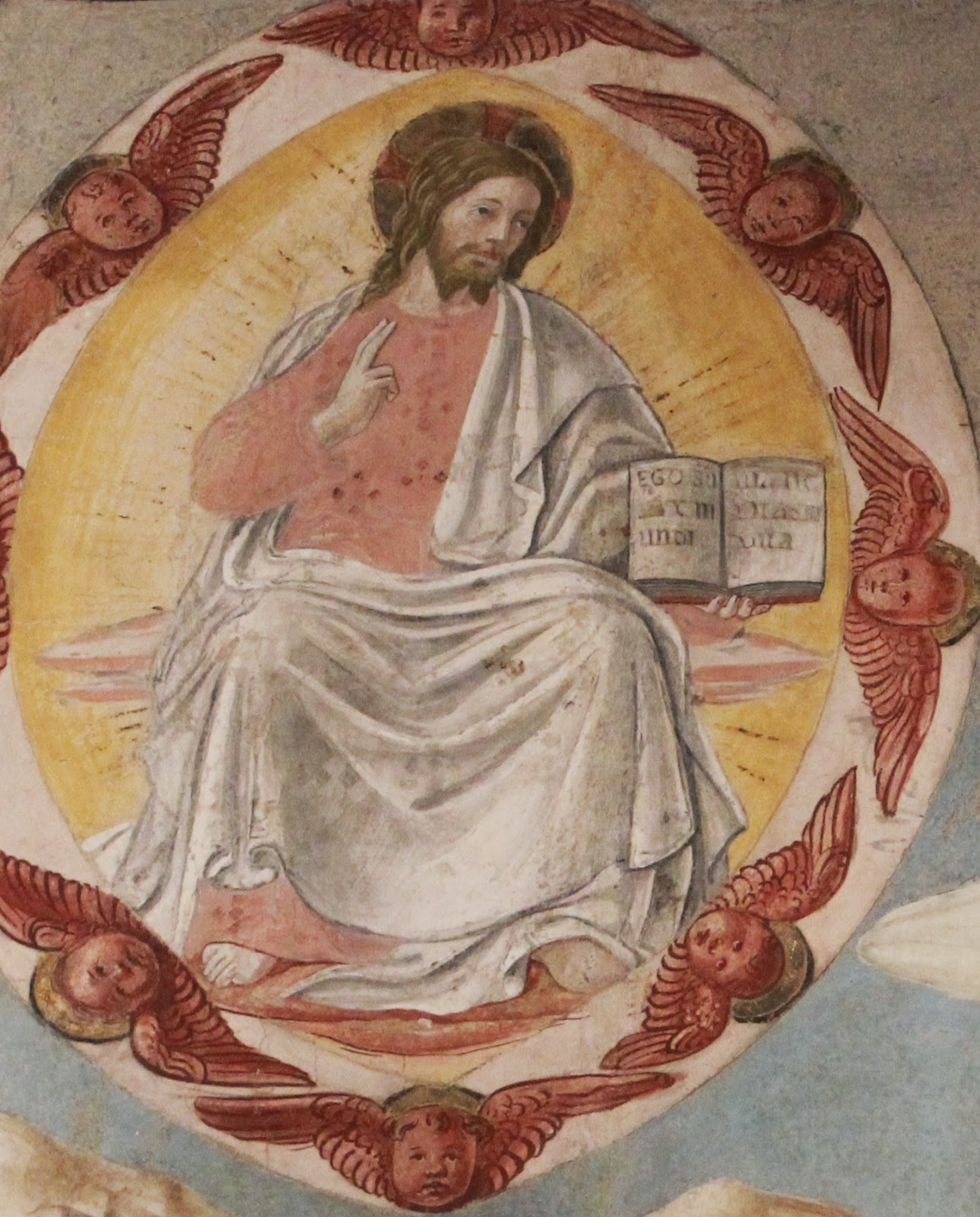
Detail of Christ enthroned.

Saint Frances heals a sick man with a bad leg.

Vision of Christ who holds her hand.

Miracle of the vineyard.

Saint Frances receives the child Jesus from Mary.

Saint Frances heals a man with nine wounds.

Vision of Saint Frances.

Detail of the miracle in the vineyard.

Saint Frances heals a young dying man.

Saint Frances heals a young hunchback.
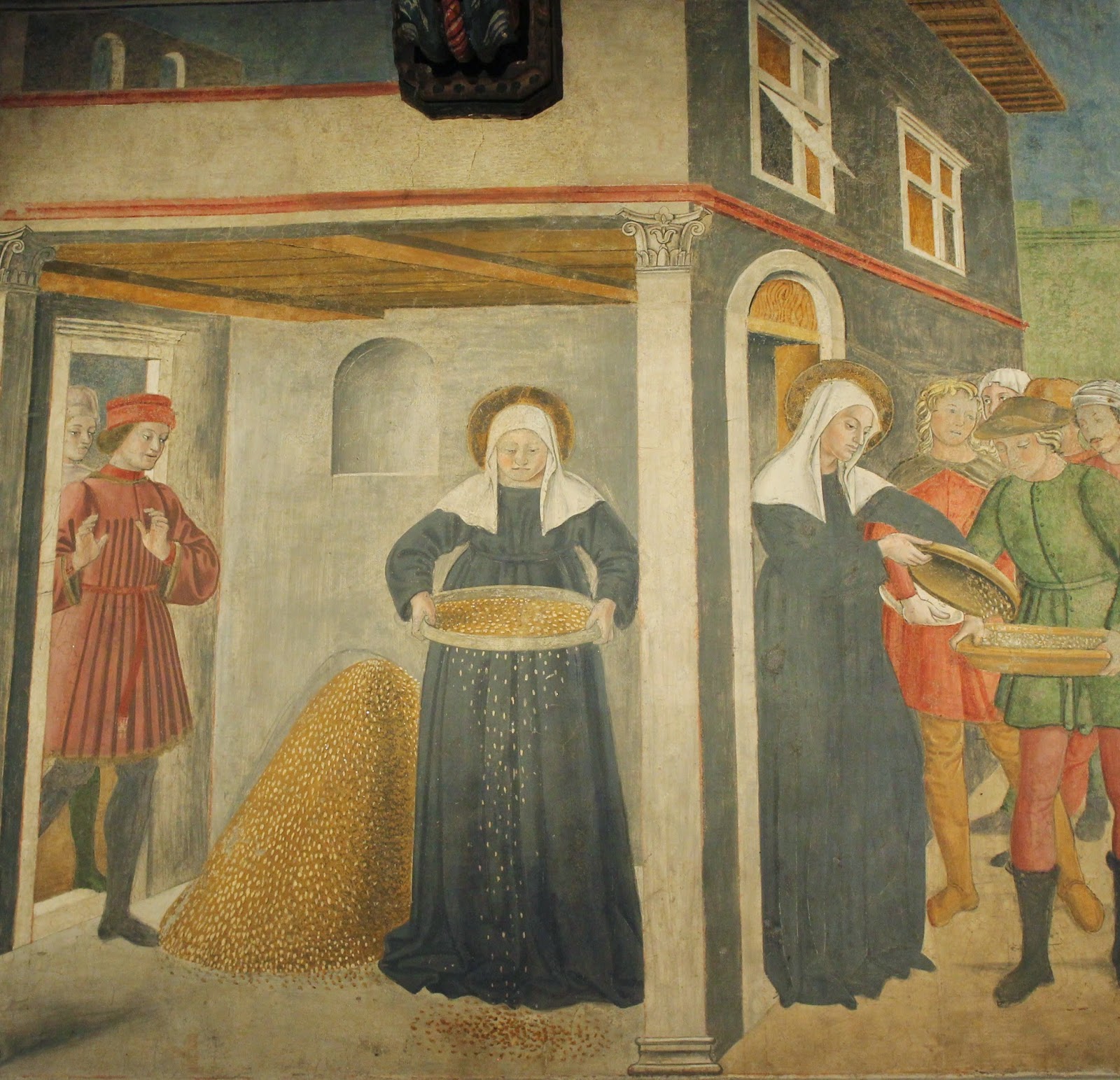
Saint Frances and the miracle of wheat.

Saint Frances heals a young man with a head injury.

Saint Frances and the miracle of wine.

Saint Frances heals a young man with a foot injury.

Saint Frances receives communion at St. Peter's.

Saint Frances resuscitates a young boy.

The original Renaissance ceiling.

The original Renaissance ceiling and windows.

Saint Frances heals a young paralytic.

Saint Frances' vision of hell.

Detail of the vision of hell.

Saint Frances heals a young man's arm.

Saint Frances oblation to the Virgin in the church of Santa Maria.

A detail of Saint Frances' funeral.
STAIRS

Risen Christ.

The Blessed Virgin Mary with Saint Frances and Saint Benedict.
THE REFECTORY
The refectory has frescoes of the visions she had of evil spirits, from which her guardian angel, with her son, saved her.
The refectory has frescoes of the visions she had of evil spirits, from which her guardian angel, with her son, saved her.

Demons beat Saint Frances while she is at prayer in her cell.

Saint Frances in her cell is tormented by demons while she prays.

While doing laundry for her infirm husband she meets three demons in disguise as monks.

Saint Frances in her cell is tormented by demons.

Saint Frances finds a rotten corpse, Satan tries to push her on it.

Saint Frances is going to her infirm husbands's room when a serpent and a lion attack her.

The demons visit Saint Frances while she is at prayer, dragging her out.

Saint Frances meets Satan in disguise as her patron saint.

Satan appears to Saint Frances as a dragon with several heads, Saint Paul saves her.

Saint Frances meets a flock of sheep, then they become wolves and dragons.

Detail of the description in old Roman dialect.